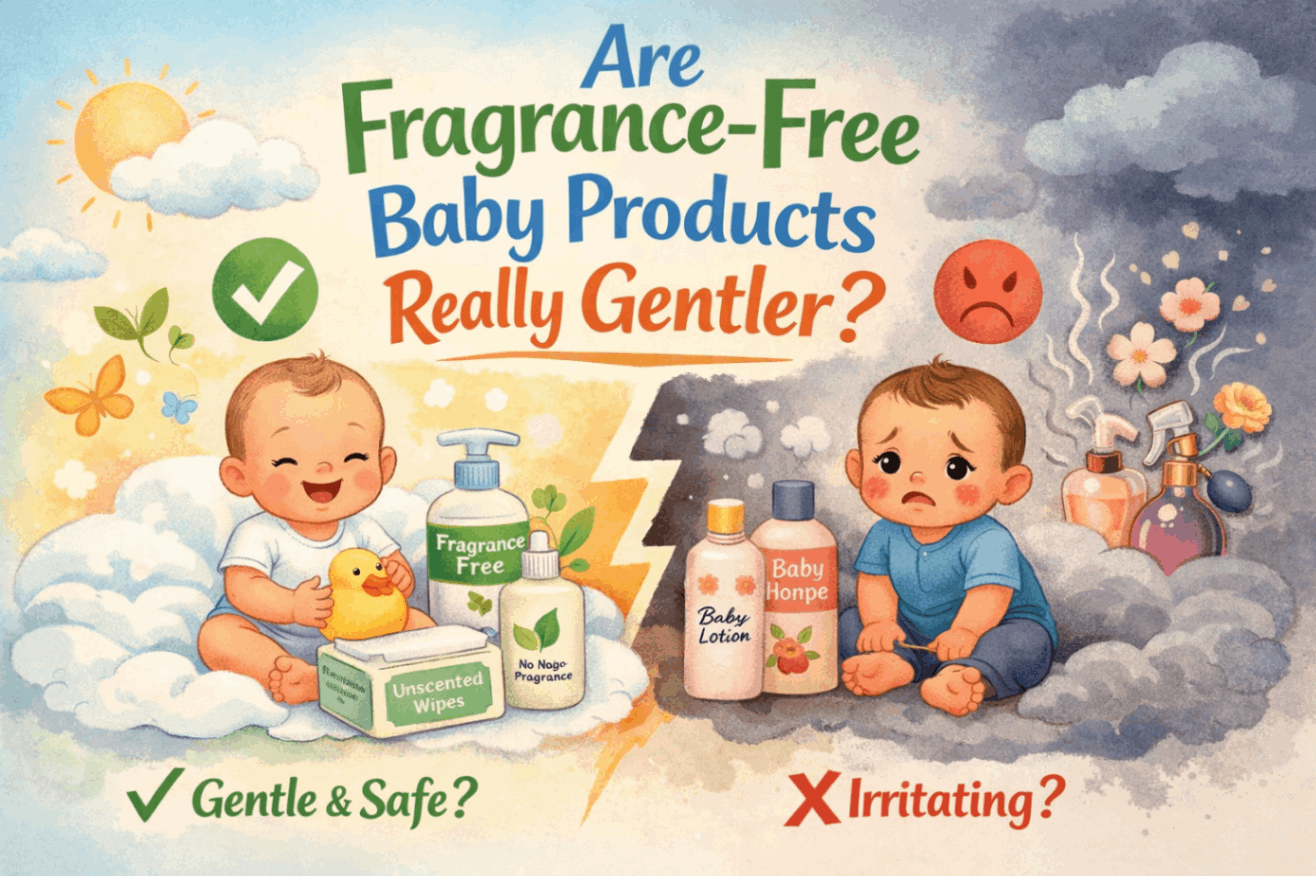












Are Fragrance-Free Baby Products Really Gentler? What “No Fragrance” Actually Means
On parenting shelves, “fragrance-free” feels like a safety badge. Many Vietnamese parents automatically reach for products labeled không mùi believing they are gentler and safer for newborn skin.
But here’s the uncomfortable truth:
Fragrance-free does not automatically mean low irritation.
Let’s break this down using risk-based thinking instead of marketing language.
1. “Fragrance-Free” vs “Unscented” — Not the Same
Many parents don’t realize these are legally different concepts.
- Fragrance-free → No added fragrance for scent purposes.
- Unscented → May still contain fragrance chemicals to neutralize smell.
Even more important:
A product can be fragrance-free but still contain plant extracts or essential oils that function like fragrance components biologically.
Your baby’s skin doesn’t react to the label.
It reacts to the molecules.
2. Why Fragrance Is Often a Problem
Fragrance mixtures are among the most common causes of contact dermatitis worldwide. That’s why removing fragrance does reduce one major risk category.
But fragrance is only one risk variable.
Other frequent irritants in baby products:
- Essential oils (even natural ones)
- Preservatives
- High surfactant cleansers
- Botanical extracts
- Overly complex ingredient lists
Removing fragrance lowers risk —
it does not eliminate it.
3. Newborn Skin Is About Barrier, Not “Sensitivity”
Parents often assume babies have “allergic” skin.
In reality, newborn skin has:
- Thinner outer layer
- Higher water loss
- Immature barrier function
That means irritation happens more easily — even from mild products.
The gentlest product is often:
- Short ingredient list
- No plant actives
- No essential oils
- Mild cleanser or simple emollient
Minimalism is usually safer than “natural enrichment.”
4. When Fragrance-Free Truly Matters Most
Fragrance-free becomes especially important if:
- Baby has eczema
- There is family history of atopy
- Baby has had previous skin reactions
- Skin is broken or inflamed
In these cases, fragrance removal meaningfully lowers flare risk.
For healthy skin?
It’s helpful — but not magic.
Risk-Based Takeaway
Instead of asking:
“Is fragrance-free the best choice?”
Ask:
“What additional variables am I introducing?”
Fragrance-free reduces one known irritant category.
But the safest baby skincare routine is usually:
Fewer products. Fewer ingredients. Fewer changes.
Parents don’t need perfect products.
They need predictable risk.